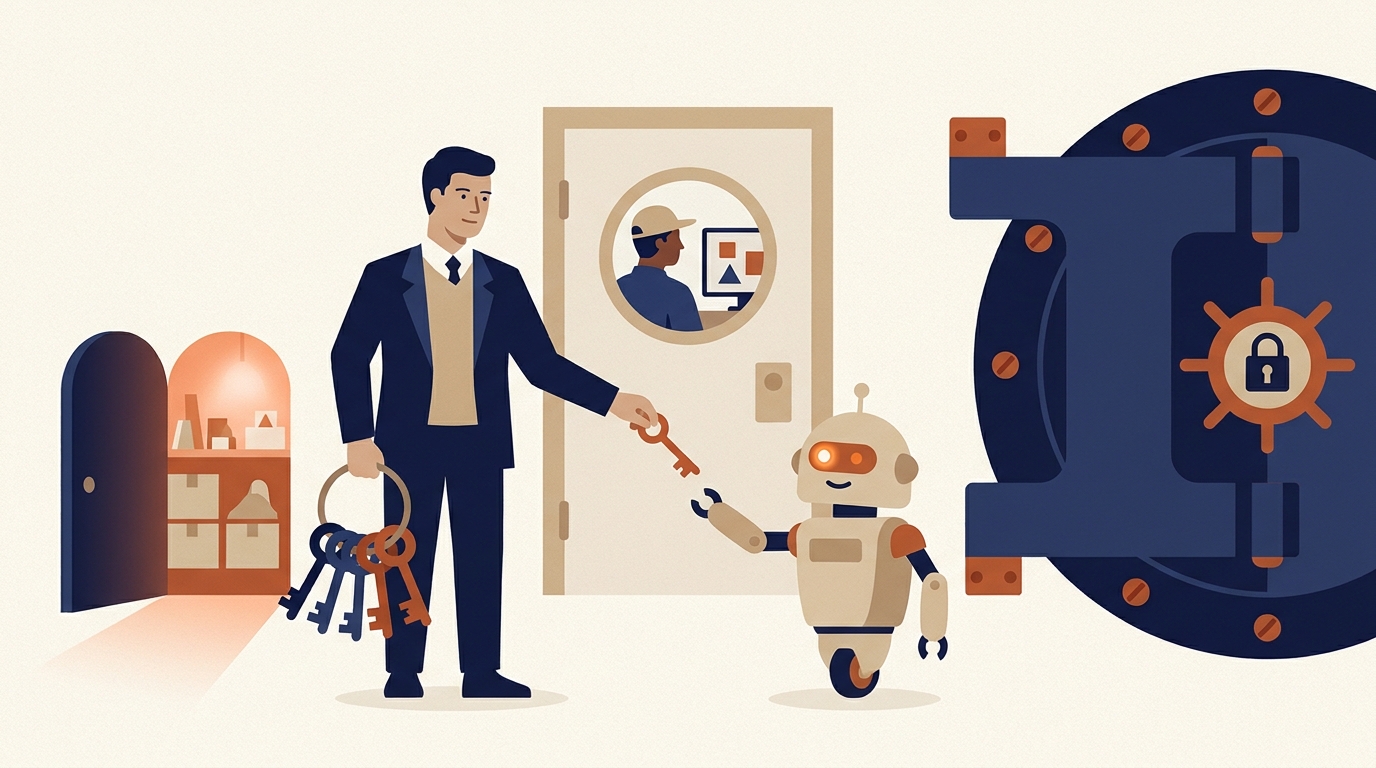
The demo and the Tuesday morning
You watch an AI demo and it looks like magic. Then you let it loose on a real Tuesday, with real prices and real suppliers, and it gets weird.
That gap is what this series is about. What is real with AI in business, and what is not yet.
What I have been doing
I have spent twenty years in consumer goods and retail. Lately I have been getting my hands dirty with AI.
My perspective comes from consulting with CPG and retail clients, and from my own experiments with AI systems that can run parts of a business. I write as an advisor and practitioner. I will keep client details general, and I will not tell client stories.
The big lesson so far
The question is not which AI tool to buy. That is the wrong shelf to be looking at.
The real question is which everyday decisions you let AI make on its own. Which ones it should only suggest. And which ones stay with a person.
Think of a new hire. You would let them restock a shelf on day one. You would not let them reset your prices on day one. AI is the same.
Where AI was quick and useful
AI was fast at drafting. Page titles, collection descriptions and promotion names came out quickly and read well, once there were clear checks around them.
It was also good at reading messy material. I pointed it at supplier spec sheets and packaging photos and it pulled out the material of a product. That is dull work a person hates.
And it was good at watching. A daily watcher that looks for changes in import duties and raises one flag is a lovely job for a machine. It changes nothing itself. It just taps you on the shoulder.
Where it tripped
Sometimes the AI did exactly what it was told, and that was the problem. A plan for a big sale came out a hair over the discount depth the rules allowed. A price sat under its floor. The planner and the publishing step each had their own idea of the limit.
Another time, an approved change quietly rewrote other settings nobody had asked it to touch. Picture asking a painter to do one wall and finding the whole house repainted.
Images were humbling. Many first tries failed the quality check. I first blamed the checker. The checker was right. The photos going in and the layouts were the real problem, so we fixed those instead of lowering the bar.
A unit mix-up was my favourite lesson. A pack size got copied wrong from one place to another. Every cost downstream was wrong, and it all looked tidy.
A rule of thumb
Here is the picture I keep in my head. Ask two things about any decision. How costly is it to get wrong? And how easy is it to undo?
If a mistake is cheap and easy to undo, let AI decide. If it is costly but you can undo it, let AI suggest and a person approve. If it is costly and hard to undo, a person decides and AI only prepares the facts.
A product title is a shelf-restock job. A price change under a running sale is not.
flowchart TD
A["A decision comes up"] --> B{"Costly if wrong?"}
B -->|"No"| C["AI decides alone"]
B -->|"Yes"| D{"Easy to undo?"}
D -->|"Yes"| E["AI suggests"]
E --> F["Person approves"]
D -->|"No"| G["Person decides"]
C --> H{"Checks pass?"}
H -->|"No"| I["Hold and flag a person"]
H -->|"Yes"| J["Done and logged"]
What it means for your business
You do not need a big AI plan. You need a short list of decisions, sorted into three piles.
Trust also has to be earned. I like to look at an agent’s track record before giving it more freedom. Evidence first, freedom second.
And the checks matter as much as the AI. Most of my stumbles were caught by a simple rule or a person looking, not by the AI noticing.
Three things to try this week
First, write down ten decisions your team makes every week. Sort each one into decide, suggest or person-only.
Second, pick one cheap, easy-to-undo task. Let AI do it for a week, and check a sample by hand.
Third, find one number that gets copied from place to place, like a pack size. Check it against the source. You may be surprised.
What comes next
This series will take one area at a time. We start with how products look and read online: the photos, titles and descriptions.
That is where AI is quickest and where the stumbles are easiest to see.
So tell me: what is one decision in your business you would happily let AI make on its own?